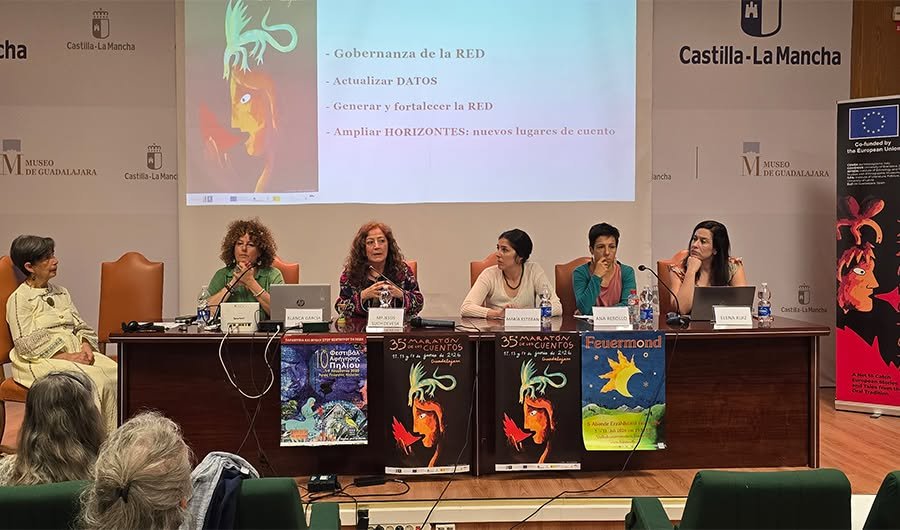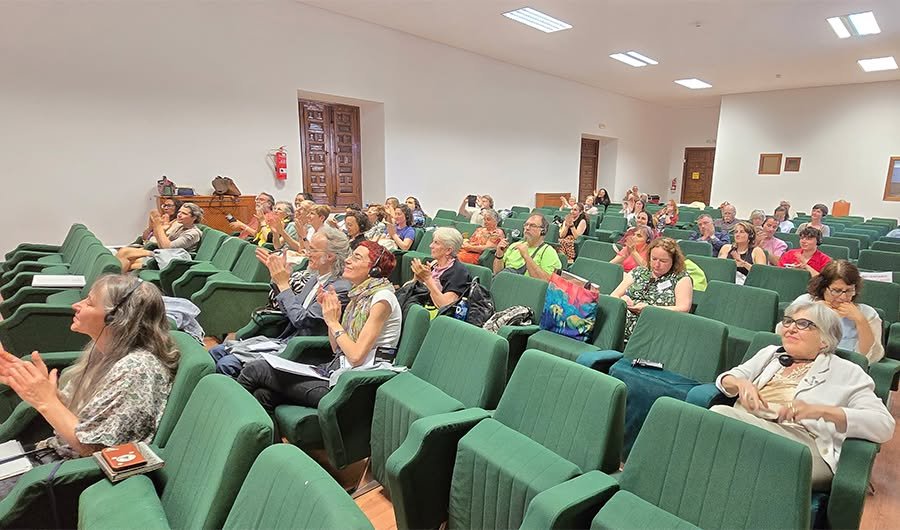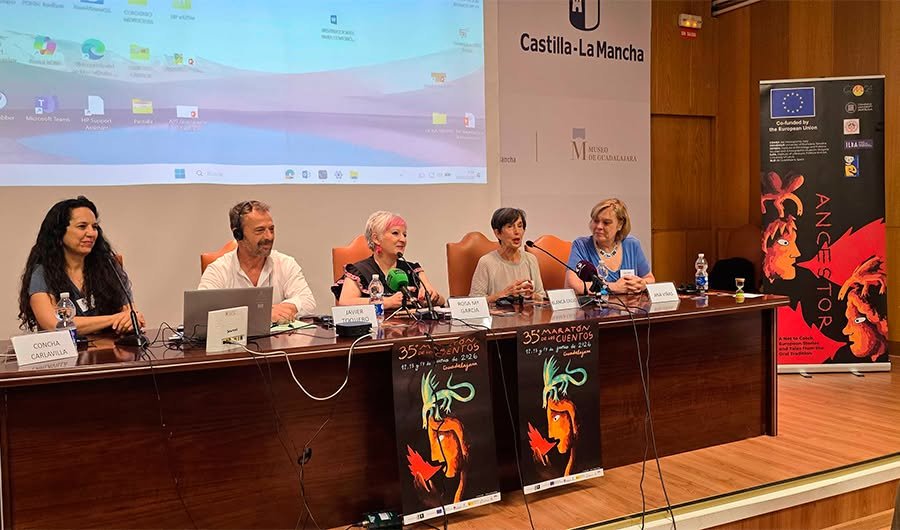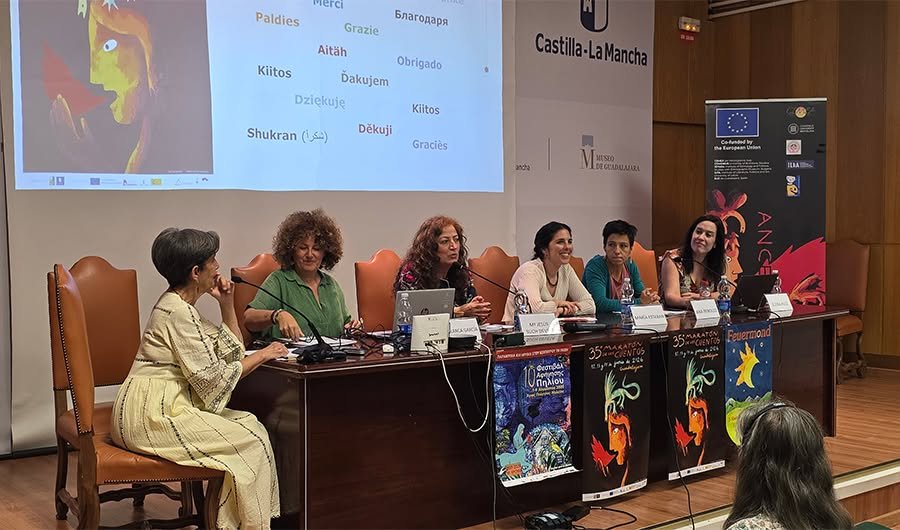
From 10 to 12 June, the Palacio del Infantado hosted the ‘Encuentro de Lugares de Cuento’ (Storytelling Places Meeting), where progress was made on designing a content network to create European routes linked to the oral tradition. These routes can help strengthen the cultural profile of these regions, promoting a model of local development rooted in intangible heritage.
This event is one of the key initiatives of the European ANCESTOR project, led by the Guadalajara SLIJ, with the aim of strengthening oral storytelling as a living cultural heritage and as a tool for cooperation between European cities and regions.
A total of 24 participants from 16 European countries have worked on the design of European Storytelling Routes. These routes aim to connect venues linked to oral storytelling, festivals, archives, cultural centres , towns and communities that preserve and pass on stories as part of their identity.
All participants built upon the work previously carried out by Blanca García Henche, a senior lecturer at the University of Alcalá in the field of Marketing and Market Research, who, together with María Jesús Such Devesa, Professor of Applied Economics at the University of Alcalá, was tasked with developing literary tourism products centred on storytelling and oral tradition.
In this regard, participants at the conference took part in two working groups to enrich and shape the initial tourism projects: Story Keeper and Storyteller.
“Following an initial proposal to the participants, one of the criteria was not to create a route as such, but rather – given that more and more people are travelling independently – to produce a fact sheet or basic information on each destination so that users can visit a website and book and organise their trip on their own,” explained Blanca García Henche. That said, routes have not been ruled out; they are proposed to be complemented by this additional destination information.
In this regard, various ‘Story Places’ from countries such as Ireland, France, Italy, the Czech Republic, Finland, Latvia, Estonia, Lithuania, Poland, Greece, Slovakia, Bulgaria, Austria, Slovenia, Portugal and Spain were presented during the meeting. Drawing on these experiences, the participants worked in groups to analyse, enrich and refine this content and the layout of the proposed routes.
In this context, García Henche highlighted the potential of stories and the oral tradition to develop cultural tourism initiatives with their own distinct identity. She emphasised that Story Routes should not be understood merely as a geographical itinerary, but “as a cultural experience capable of connecting stories with places, communities and the collective memory of each region”.
The lecturer at the University of Alcalá argued that oral storytelling offers an opportunity to develop sustainable, distinctive tourism initiatives that respect the authenticity of places. She thus emphasised the ability of stories to create memorable experiences, as they allow visitors to engage not only with a destination, but also with the way in which that place is recounted, remembered and shared.
She added that this type of route can help to strengthen the cultural profile of regions, promoting a model of local development linked to intangible heritage, community participation and the creation of networks between institutions, cultural actors and European venues associated with the spoken word.
“We have identified the need to clearly define and, as far as possible, undertake the task of generating information so that there are more opportunities for many other organisers of events with similar characteristics relating to the oral tradition – which is, so to speak, the link that ties everything together – to join the network,” adds María Jesús Such Devesa, Professor of Applied Economics at the University of Alcalá. In this regard, she emphasised that “we are still part of an incomplete European network, with scope for expansion and, therefore, with great potential for generating information. And that does not rule out the possibility of it becoming a network extending beyond Europe”.
The work carried out by both professors was supported during the conference and in their research by Ana Rebollo Benito, head of the Tourism, Trade and Crafts Service at the Provincial Delegation for the Economy, Business and Employment in Guadalajara; Elena Ruiz Sanz, head of the Tourism Service at Guadalajara City Council; and María Esteban Cajero, tourism officer at the Guadalajara Provincial Council.
The Storytelling Sites Meeting concluded with the presentation of a proposal advocating the creation of a meticulously maintained database of all Fairytale Places, containing highly specific and informative data, so that people wishing to organise a Fairytale Route for their holidays can plan it using this information, which must be available on a website that is constantly updated. This new initiative, will also enable the Network of Story Places to expand its reach beyond Europe, with the aim of building a Global Network of Story Places.
The event also coincided with the start of the Storytelling Marathon, which ran from Friday until yesterday and is one of Guadalajara’s most iconic cultural events, reinforcing the link between the local dimension of oral storytelling and its European reach.
The ANCESTOR project, whose full name is ‘A Net to Catch European Stories and Tales from the Oral Tradition’, has been selected under the Creative Europe programme and aims to revitalise the European oral tradition through storytelling, training, international cooperation and the creation of new networks between cultural and academic institutions and regions linked to storytelling.
With this event, Guadalajara consolidates its role as a leading city in oral storytelling and takes a step forward in building a European network that transforms stories into shared heritage, a cultural experience and an opportunity for the future.